






Credit: Wikipedia
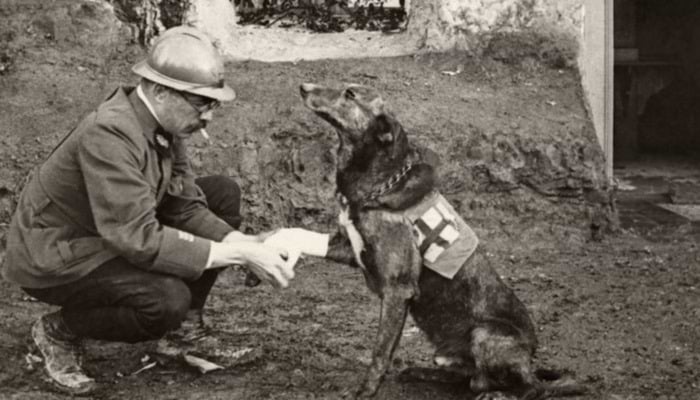
World War I marked the first occasion when dogs were used by the military on a massive scale. More than 50,000 dogs served during the Great War, demonstrating that they really are man's best friend. As Great Britain prepares to commemorate the centenary of the end of World War I on 11th November, the nation is paying tribute to everyone who served their country to defend our freedom. The British troops faced great hardships during the war - in particular, the thousands of soldiers taking part in trench warfare across Europe lived in harsh, damp and unsanitary conditions, buried into the cold ground, facing death every day. They relied on their four-legged friends, not only for simple companionship but also to give an early warning of an impending attack and even to carry medical supplies across the battlefields. The dogs' bravery knew no bounds and they endured the noise and smells of warfare unflinchingly. War dogs' history Although dogs had been used in warfare on a lesser scale in the past, the 1914 to 1918 war was the first time they had been mobilised on a major scale. Throughout the centuries, dogs have been mentioned as being part of wars, most notably in 281 BC, when the Macedonian officer Lysimachus, serving under Alexander the Great, was killed in battle. Historic writings revealed that his faithful hound refused to leave Lysimachus' body on the battlefield and was found guarding his late master. Historic records uncovered in 2013 revealed the true extent to which dogs were used during World War I. A collection of old newspapers was unearthed, detailing how dogs lived in the trenches, side-by-side with their human companions, enduring unthinkable hardship and showing intense loyalty to the troops. Dogs' role in WWI The dogs who went to war included around 7,000 who had been pets and others from the police force and dogs' homes. They were considered so important to the war effort that the War Office set up the Hampshire-based War Dog School of Instruction specifically to train them. Among the most popular dogs were medium-sized breeds, such as German Shepherds, Doberman Pinschers and collies. It wasn't only the British who used dogs - other European nations and the Americans also had them among their ranks. The dogs had many different jobs, including the role of sentry and watchdog. They were trained to sit or stand silently at the top of the trench, next to their master, alongside his gun barrel. Their job was to let the soldiers know if any enemy troops were approaching the barbed wire. A report in the Dundee Evening Telegraph in 1916 described how the watchdogs were trained never to bark at the approach of a hostile force, using only a low-pitched growl to let his master know someone was approaching. The report continued that in many cases, the "mere pricking of the dog's ears" was enough to alert the soldier to the enemy in the vicinity. A report in the Sunday Post described the dogs as being on "outpost duty" on the frontline. Scouts and guards Dogs were also used on patrol and became scouts skilled at detecting foes much sooner than their human handlers. As well as sensing humans were present, the dogs could also sniff out chemicals and gas attacks before the soldiers had any inkling. Dogs were deployed to guard munitions, railways, supplies, the trenches and barracks. They were also used to guard prisoners of war. Serving on the front line, the dogs' presence could often prevent the enemy from getting close enough to the British line to effectively throw grenades. Ambulance dogs One of the most dangerous jobs was carried out by the ambulance dogs, also known as Red Cross dogs and “mercy dogs”. Their role was to find and assist the wounded in no man's land on the battlefield between the trenches. The dogs carried medical supplies and if the wounded men were able, they could treat themselves once the dogs had sniffed them out. The dogs were also trained to take the wounded soldier’s cap to the medics and then lead them back to the casualty. If the soldier was dying, the dog would sit with him to provide comfort in his final moments. Among the popular breeds for sniffing out the wounded were bloodhounds and Airedale terriers. Sadly, many dogs were killed alongside the medics in the line of duty. Eventually, many units stopped using ambulance dogs on the Western front, because the casualty rate was so high. On the Eastern front, however, the use of dogs continued and during the Russian retreat, they reportedly saved thousands of German soldiers' lives. Couriers and messenger dogs Communication was an ongoing problem in the trenches, where heavy shelling destroyed the telephone lines. In the thick smoke and noise of the artillery, trained dogs delivered messages tied to their collar during combat, often having to leap over barbed wire fences. They also carried small supply packages to soldiers in the trenches, containing food, cigarettes and even explosives. Their size, speed and agility helped them to evade enemy gunshot over the difficult terrain. Some larger military dogs were trained to pull small vehicles filled with supplies, arms and equipment. There were also teams of dogs who were trained as sled dogs to pull soldiers across the rough ground. In the north of France, huge kennels were built for the war dogs, with the ambulance and sentry dogs housed near the front. Courage and tenacity An article in the Aberdeen Evening Express in 1918 quoted Lt Col Richardson, who ran the War Dog School of Instruction, as saying: "The skill, courage and tenacity of these dogs is amazing." He described how the dogs had continued on their way, even during heavy gunfire, with the messenger dogs delivering messages of vital importance when all other lines of communication had been cut. As Remembrance Sunday services take place across the UK next month, people everywhere will be remembering not only the fallen humans but also the brave dogs who gave their life more than 100 years ago. Griggs' country store, in Cornwall, will be joining the rest of the nation in paying tribute to those who died for our freedom. As a stockist of high-quality outdoor clothing and leisurewear, from brands such as Barbour and Hunter, our clothing is ideal for dog walking. Man’s best friend truly is his dog!