







© NASA
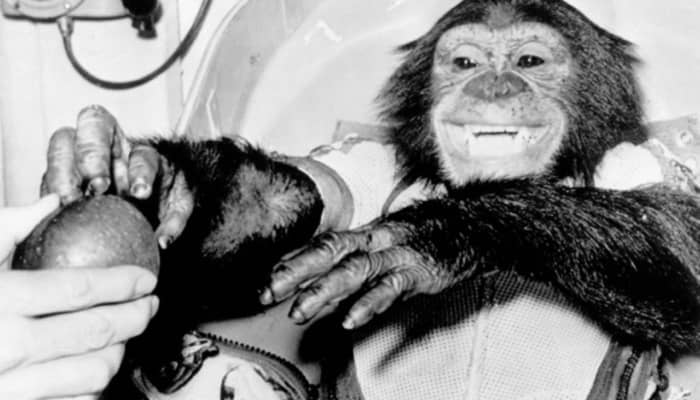
Celebrations are taking place this year to mark the 50th anniversary of the moon landing on 21st July (0256 GMT) 1969 by United States astronauts Buzz Aldrin, Neil Armstrong and Michael Collins, known collectively as the crew of Apollo 11. While the human race is celebrating its achievement in conquering space, animal welfare groups are remembering the non-human space travellers who never returned. The practice of sending animals into space to pave the way for human exploration has been steeped in controversy over the years. Experiments by American space agency NASA and their counterparts in the Soviet Union and China have involved sending hundreds of animals into space. Sadly, many of them died in the name of scientific research. By the time astronauts finally walked on the moon in the summer of 1969, space agencies across the world had been conducting experiments with other living creatures since the 1940s to ascertain whether space travel would be safe for people. Animal space travel history Animals had been used to test the safety of flight long before space travel began. The first animals to be sent on a solo flight went up in the latest innovation (a hot air balloon) in the 18th century. Wealthy paper manufacturers, Joseph-Michel and Jacques-Étienne Montgolfier, of Annonay, France, experimented with creating devices that could fly, after noticing hot air directed into a paper or fabric bag caused it to rise. Before trying out their subsequent invention (the hot air balloon) on people, they sent it on a flight piloted by a duck, a sheep and a rooster. Perhaps surprisingly, the balloon landed safely and the trio of furry and feathered crew members made it back to earth in one piece. Fast forward two centuries and people had begun experimenting with space travel. The first living creatures that flew to space were fruit flies, in an experiment carried out by American scientists in 1947. The flies were launched aboard a V2 rocket, reaching a height of 68 miles, before being safely parachuted back to earth. They were recovered alive after their momentous journey. Most famous space animals Spurred by the success of their experiment, the scientists launched a V-2 Blossom spacecraft on 11th June 1948, from White Sands, New Mexico. Onboard was a rhesus monkey named Albert I, who sadly died when the spacecraft failed before even reaching the peak of its ascent. Undeterred, on 14th June 1949, the scientists launched a second V-2 flight carrying Albert II, a laboratory monkey owned by Air Force Aeromedical. The flight reached an altitude of 83 miles, but Albert II also died when the parachute failed on the way back to earth. He died on impact as the craft plummeted back from outer space. Another V2 rocket was launched by NASA in 1950, this time containing a mouse. Photographs taken in space showed the mouse was alive as it reached an altitude of 85 miles, but the rocket disintegrated, and the tiny astronaut died due to parachute failure. A total of 32 monkeys have flown in space, including squirrel monkeys, pig-tailed monkeys, rhesus macaques and cynomolgus monkeys. Chimpanzees have also flown into space. Around one-third of the monkeys sent into space in the 1940s and 1950s made it back safely. In the 1950s, the Soviet Union rounded up stray dogs off the streets and sent 12 of them into space. The logic was they were used to living in cold, inhospitable conditions, so they would be hardier than laboratory dogs. None of them made it back safely. The most famous was Laika, who was sent up alone on Sputnik 2 on 3rd November 1957. She became the first living being to orbit the earth, but she died from a combination of heat and stress several hours into the flight. It was reported that there had never been a re-entry strategy, as the mission was assembled quite hastily. The plan was not to bring her back but to see how long she would survive in space. Imagine the outcry if this had been their attitude to human astronauts! On 28th May 1959, two monkeys, Able and Baker, a rhesus and a squirrel monkey respectively, were the first to return to earth alive after a space flight. Animal astronauts in the 1960s On August 19th 1960, the Russians sent up their Soviet Sputnik 5 rocket, containing two dogs called Belka and Strelka, a rabbit, 42 mice, two rats and many fruit flies. They returned to earth safely after their flight. On 31st January 1961, Ham the chimpanzee was launched into space by NASA. The four-year-old chimp was sent up in a Mercury capsule. He survived the flight and lived in retirement until the ripe old age of 26. He died in January 1983. A second chimp, Enos, was sent into orbit in a Mercury spacecraft on 29th November 1961. He also survived and was returned safely to earth. The first cat in space was launched by the French on 18th October 1963. The female cat, Félicette, had electrodes implanted under her skin. They transmitted her condition while she was in orbit. She returned safely to earth after reaching an altitude of 100 miles. China was known to have launched dogs, rats and mice between 1964 and 1966. In February 1966, the Soviet Union sent up two more dogs, Ugolyok and Veterok, who orbited for a record 22 days. Their record for the longest space flight by dogs has never been broken. They returned safely to the earth on 16th March 1966. In 1968, the Russian Zond 5 was the first spaceship to circle the moon. Onboard were two tortoises, flies, mealworms and a selection of plants and seeds. They returned safely, but the unfortunate tortoises were killed and dissected on their return to find out the effects of space travel on their bodies. Their liver and spleens were found to be in a poor condition, but scientists decided this wasn't as a direct result of the space flight, but rather it was connected to the fact they had starved while on board. NASA sent up a series of biosatellites in the late 1960s, mostly carrying insects and frogs' eggs. The final biosatellite had a pig-tailed monkey on board, but he died from a heart attack. Last animals in space After the moon landing of 1969, animals no longer had to endure being sent into space. However, spacecraft still sent up various insects and algae. The last known living creatures, apart from humans, to be sent into space were two female European spiders, known as Anita and Arabella. The common garden spiders were put aboard the Skylab, NASA's space station, in 1973, where they were observed spinning webs for a total of 59 days. The last known animal to fly into space, on 17th March 2009, was a bat, who sadly did so by accident. The creature landed on the space shuttle Discovery's external fuel tank as the countdown to launch the STS-119 mission began. It was still clinging on as the space shuttle began its ascent, although scientists said it would have died quite quickly because of the intense heat. In 2010, there were media reports that the Iranian Space Agency had sent two turtles, a mouse, a monkey and worms into space to celebrate its 30th independence day. The animals had apparently returned safely to earth, although none of this was officially confirmed. Animal welfare concerns Animal welfare campaigners have long criticised the practice of sending living creatures into space, as unlike humans, they don't have a choice. The Cruelty Free International organisation has called the practice of using animals "cruel" and "pointless". Fellow animal welfare body People for the Ethical Treatment of Animals has labelled the experiments as "cruel and curiosity-driven". The website, The Dodo, which describes itself as being "for animal people", says the animals weren't "heroes", as the space agencies tried to claim. They were "like canaries in a coal mine" and were used without any concern for their well-being, to check whether it was viable to send humans into space. An editorial on The Dodo site wondered why a nation would conduct experiments which amounted to "sending a household pet on a kamikaze mission into space". What are your views on sending animals into space? Was it a vital part of research or simply a needless loss of animal lives? Here at MA Grigg’s country store, we aim to provide animal lovers with garments and accessories that will benefit both human customers and their four-legged friends! Whether you work with animals or care for household pets, we have something for everyone. Please contact us for further information about our wide range of high-quality products.